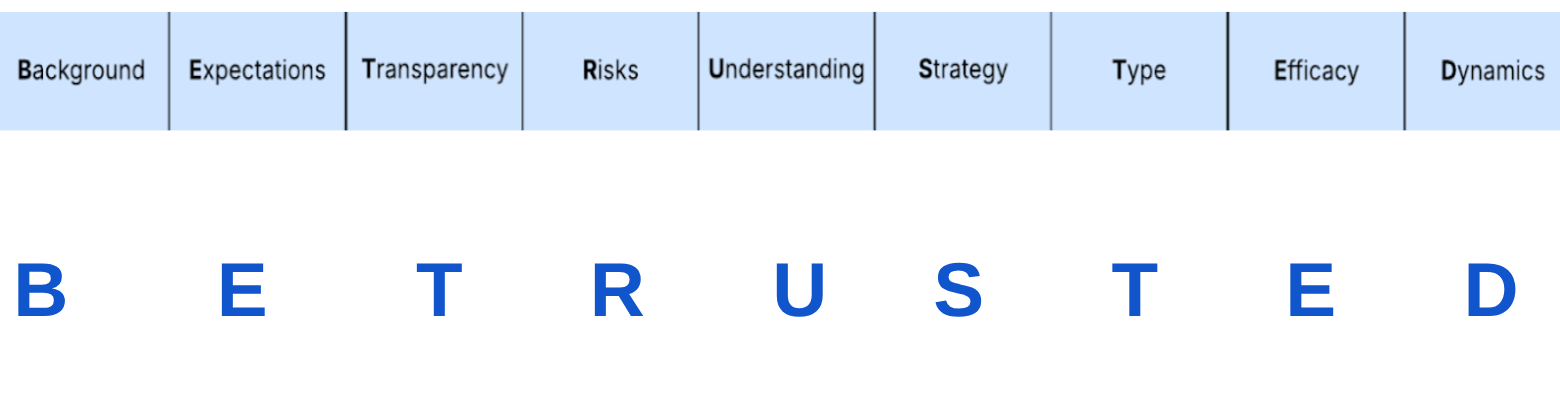
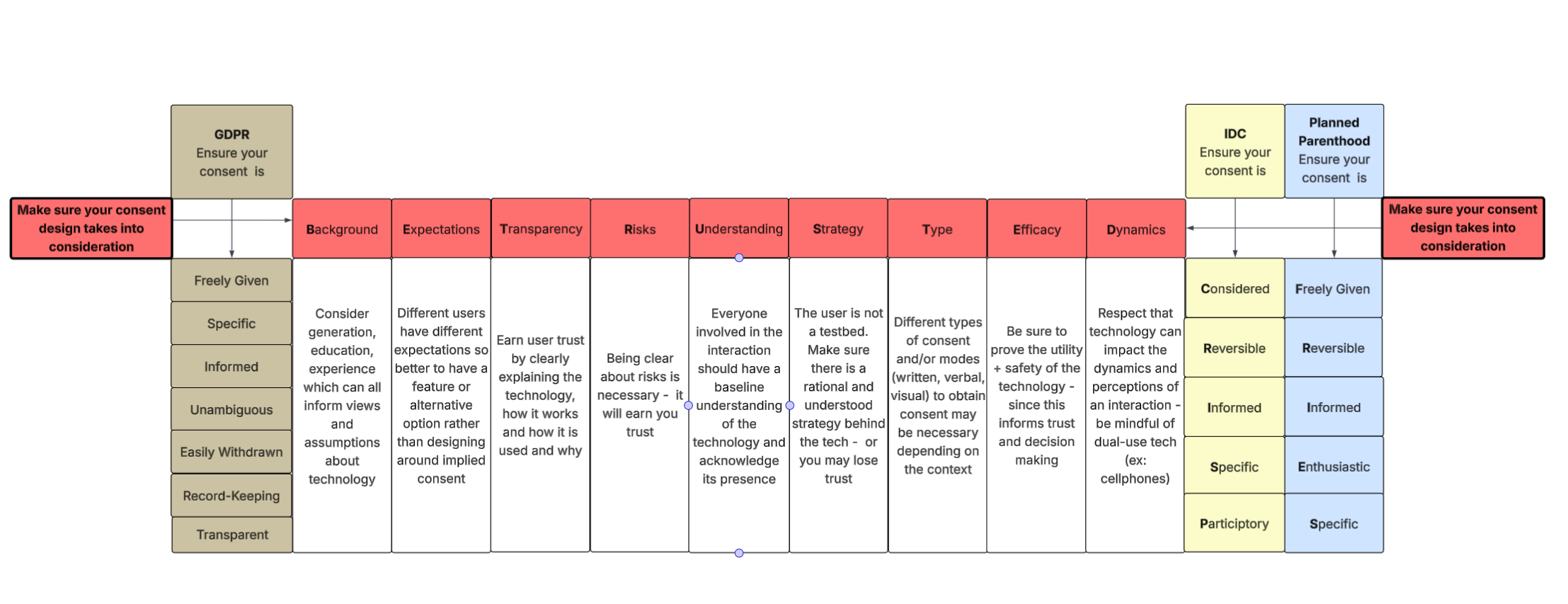
Together, these principles are the contextual factors we found are relevant and essential to making consent meaningful for users. We have a lot of great principles that articulate the specific requirements for consent (such as GDPR, FRIES and CRISP) - but we lack principles that ensure we can actually meaningfully meet these requirements - which is where the BE TRUSTED principles come in. These new contextual principles can complement existing consent requirements
CONTEXTUAL CONSENT FRAMEWORK
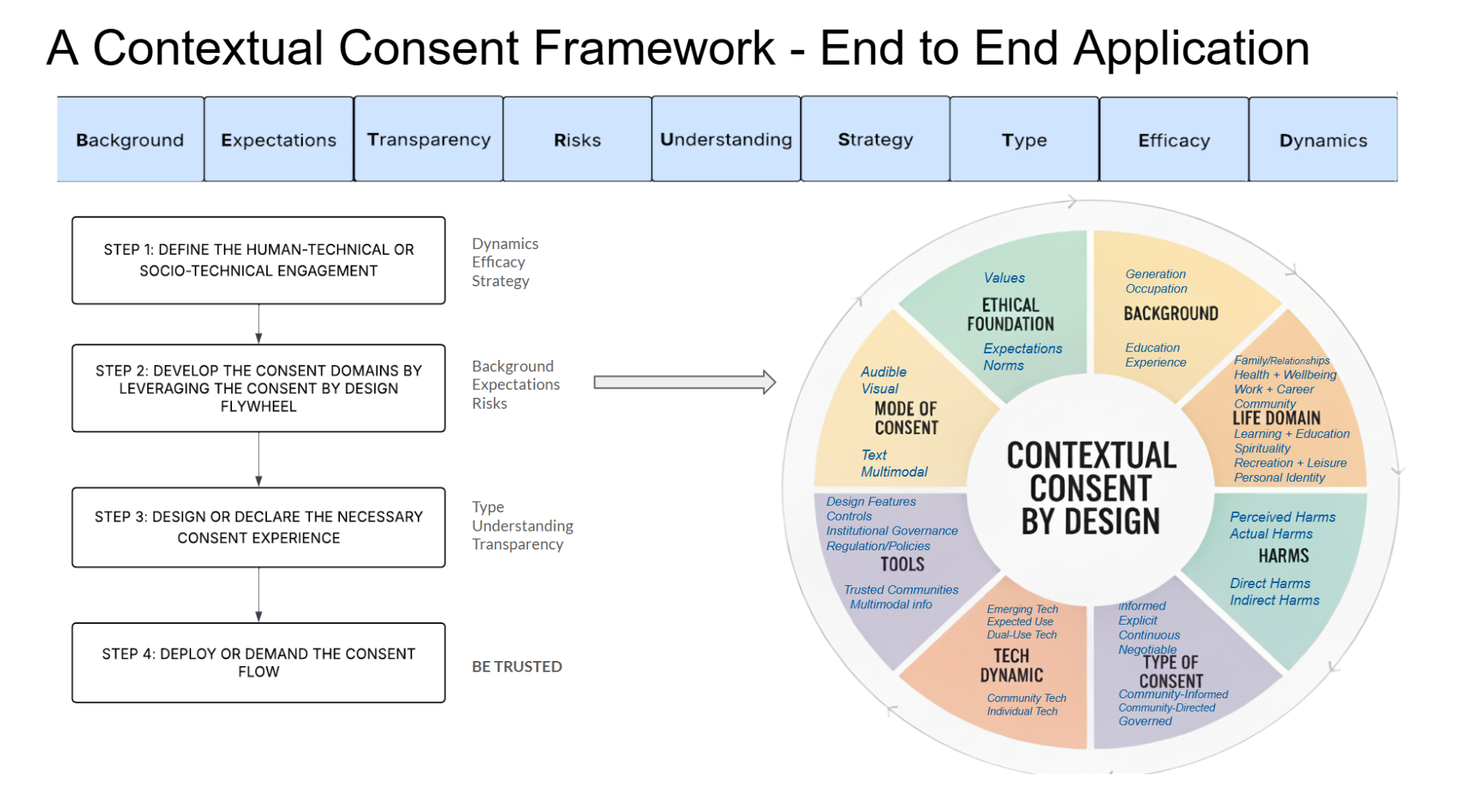
The Contextual Consent Framework provides a standardized way of applying the principles into real world situations along with a consent by design flywheel which is a tool to help its users understand and systematically cover the key domains that support a strong consent design.
The framework combines the BE TRUSTED principles which need to be considered when designing consent flows into human-technical and socio-technical interactions; the four steps that enable the operational application of these principles in practice and a flywheel that defines the key domains of contextual consent.
CONTEXTUAL CONSENT BEST PRACTICES
Key operational best practices for designing consent into technology include:
proving the utility and safety of the technology
being transparent about risks
recognizing users will disengage when things are sufficiently unclear
ensuring everyone involved has a baseline understanding that technology is present
acknowledging that technology changes interaction dynamics
using community consultation when shared impacts or high-stakes risks are involved.
Consent Thresholds:
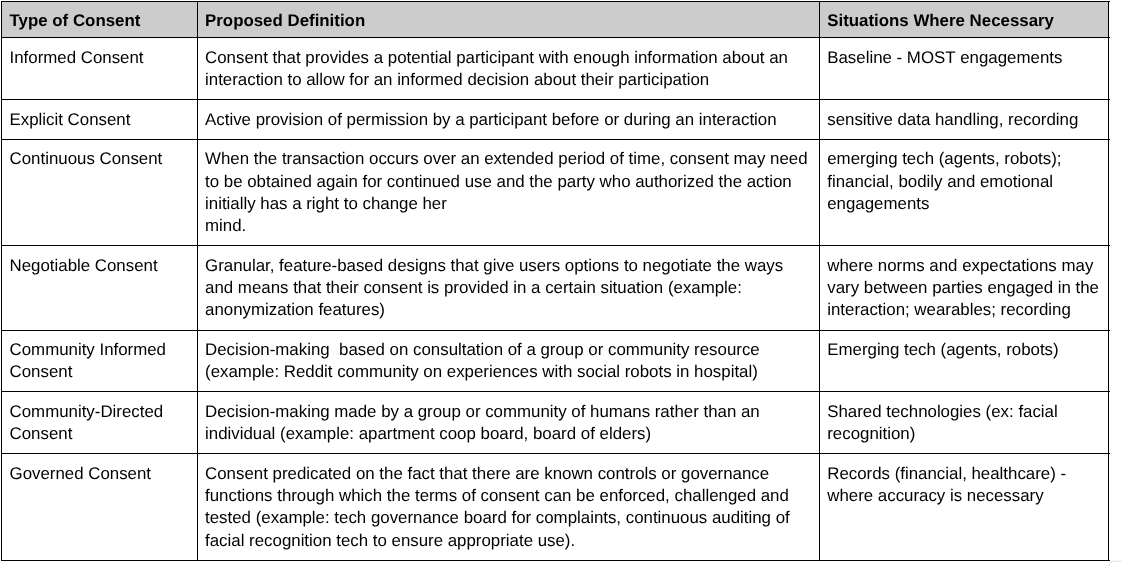
Different contexts require different “thresholds” of consent. The following guidance summarizes when each type is most appropriate:
Informed Consent Most interactions have a standardised level of the Informed Consent where the intention is to furnish enough information to make a decipherable decision.
Explicit Consent All sensitive data, recordings or cases situated at higher levels of risk should be explicitly consented.
Continuous Consent applies to new or standing technologies (e.g., agents, robots) and cases with monetary or physical or emotional importances, where the consent might require renewal with time.
Negotiable Consent is used when the norms and expectations may differ among parties (i.e. recording), the users require more advanced options than yes/no.
Community-Informed Consent finds application in emerging technologies where beneficiaries of the technologies utilise community consultation in decision-making.
Community-Directed Consent should be used in case of shared technologies with an impact to groups (e.g., facial recognition), as the decision should be taken or directed by the community.
Governed Consent should be used in cases of where accuracy and enforceability are a requirement (e.g. financial or healthcare contexts)
Modes of Consent:
The mode of consent should match the context and the user’s needs:
Audible consent works well in 1:1 settings and sensitive data contexts where verbal explanation improves clarity.
Visual consent supports “run-time consent” needs where users must understand what is happening in the moment.
Readable consent is most suitable when convenience is the primary value and information must be quickly scannable.
Multimodal consent is best for emerging technologies or situations where norms are being challenged and users need more than one format to understand and decide.
Quick Decision Guide:
Use these questions to determine what level and mode of consent is needed:
Start by defining the scenario clearly.
Then ask:
how does technology change the dynamic?
Is the technology emerging or unfamiliar?
Who is the target audience and what is their demographic context?
Are the desired norms clear and widely shared, or is there likely disagreement?
Based on the answers, choose the consent threshold
informed
explicit
continuous
negotiable
community-informed
community-directed
governed
Lastly, select the most suitable mode
audible
visual
readable
multi-modal
